In this in-depth report, we analyze the 2026 investment landscape of Asia’s battery energy storage system (BESS).
- Understanding BESS business models – from front-of-the-meter (FTM) to behind-the-meter (BTM), hybrid systems and different merchant and non-merchant revenue streams
- Understanding the evolving landscape of BESS – with rapidly reducing cost
- Financing instruments for BESS – from high-risk countries to more established countries
- An in-depth analysis of BESS opportunities in 11 Asia-Pacific economies (Australia, Bangladesh, China, India, Indonesia, Lao PDR, Malaysia, Pakistan, The Philippines, South Korea, Thailand, Taiwan, and Viet Nam) including policy environment for FTM, BTM, electricity prices and market structures, and policy ambitions.
Executive Summary
Battery energy storage systems (BESS) are becoming a core part of Asia’s power-sector transition. Growing solar and wind capacity is increasing demand for flexible capacity, frequency control and reliable supply, while battery costs continue to fall. The report estimates around 100 GW of BESS deployment across Asia-Pacific by 2030, in addition to around 160 GW in China. Yet, policy ambitions vary widely across the observed countries
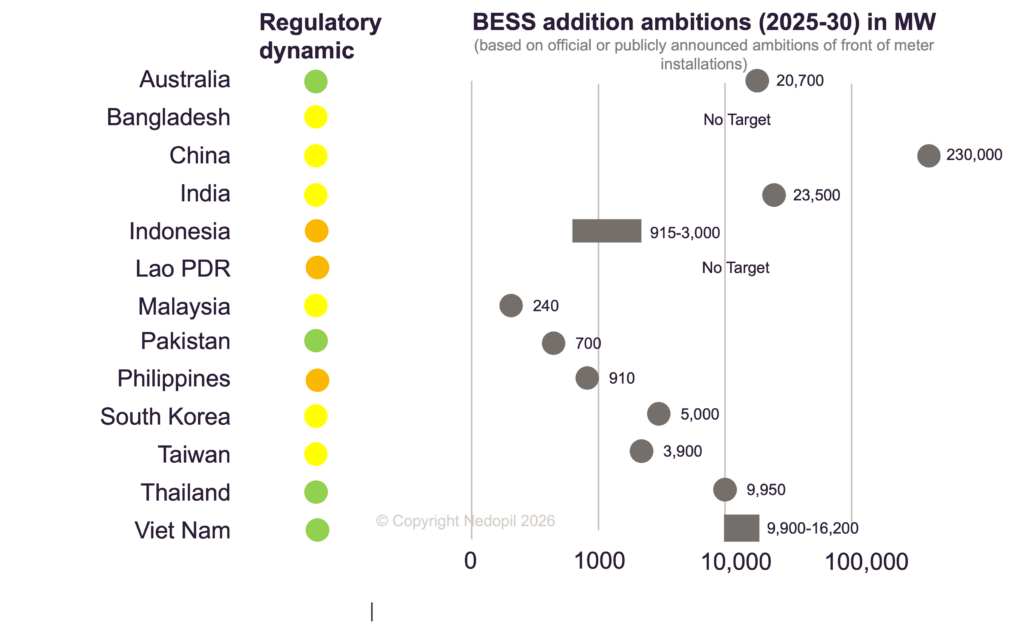
For investors, the opportunity is highly market-specific. Project returns depend on the services a battery can provide, the rules and tariffs that pay for those services, the ability to combine revenue streams, grid-connection costs, counterparty quality and the availability of suitable finance. A low-cost battery does not compensate for weak tariff design, unavailable market access or an unbankable revenue profile.
Report scope and audience
The Investor Guidance for Asia Battery Energy Storage Systems (BESS) 2026 is based on a regional survey, expert interviews and desk research undertaken from February to July 2026. It is written for infrastructure and institutional investors, banks, developers, utilities, strategic investors, corporate energy users and policymakers. It assesses business models, market rules, technology and sizing, siting and finance across Australia, Bangladesh, China, India, Indonesia, Lao PDR, Malaysia, Pakistan, the Philippines, South Korea, Taiwan, Thailand and Viet Nam, and includes project cases in Pakistan and Indonesia.
What investors need to test
A BESS project needs a defined system or customer value proposition and a credible path to monetize it. The main value pools are:
- Energy arbitrage: charge at low prices and discharge at high prices.
- Ancillary services: frequency response, voltage control, reserves and black-start capability.
- Capacity and availability payments: contracted revenue for reliable capacity.
- Renewable firming: store curtailed or clipped solar and wind output and deliver a more predictable product.
- Cost avoidance/investment deferral: defer grid upgrades or relieve congestion at substations and load centres.
- For industrial and private consumers, reduce demand charges, shift load across time-of-use tariffs, increase solar self-consumption and avoid diesel use or outage costs.
Before committing capital, investors should establish the position in the local policy environment:
- Is storage legally recognized and licensed as a distinct asset class.
- Can assets operate fully to charge, discharge and participate in energy, ancillary-service, reserve or capacity markets.
- Is revenue stacking permitted and operationally feasible through metering, dispatch and settlement rules.
- Do network fees apply on charging, discharging or both, and whether these charges undermine arbitrage margins.
- What is the creditworthiness of the utility, offtaker, optimizer and EPC/O&M counterparties.
Revenue stacking is a material. Batteries that can combine energy trading, ancillary services, capacity value and local network support have a more diversified revenue base. The report identifies major constraints on stacking in the Philippines, Taiwan, Malaysia, South Korea and Thailand. In these markets, projects may need a tolling arrangement, availability payment, firm offtake agreement, subsidy or concessional capital.
Front-of-the-meter/behind the meter: where to invest in Asia
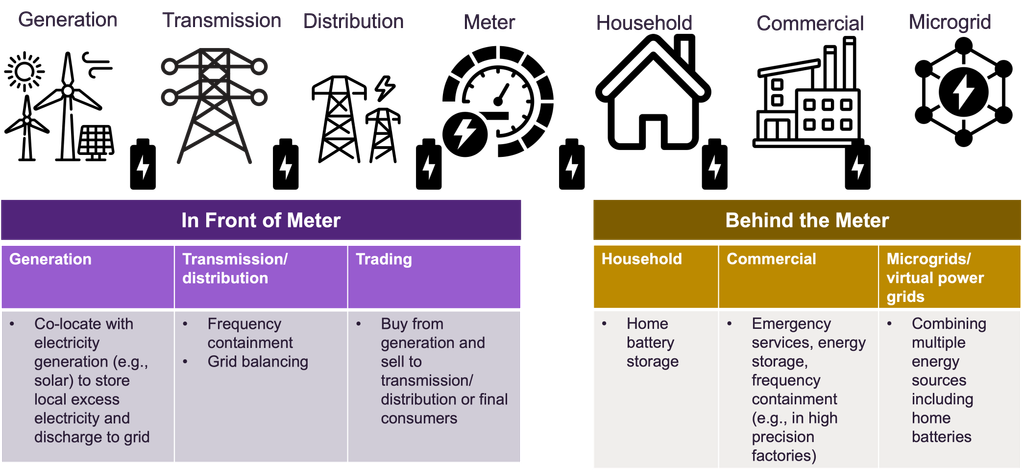
Front-of-the-meter (FTM) storage includes standalone utility-scale BESS, renewable-plus-storage projects and batteries providing transmission or distribution support. Its strongest economics are found where price volatility, ancillary-service remuneration, storage market access and grid connection align.
| Economy | Investor reading | Main FTM opportunities | Main constraints or risks |
| Australia | The most developed multi-revenue market in the survey | Reported summer spread of about USD 200/MWh; arbitrage, ancillary and reserve services, capacity mechanisms, hybrid projects, virtual power plants and revenue stacking | Merchant revenues and ancillary-service prices can decline as capacity grows; connection and congestion risks still require site-level analysis |
| Bangladesh and Lao PDR | Early-stage markets for public or contracted deployment | Hybrid systems, utility-led procurement and grid-support applications | Long-term-contract structures and weak market pricing limit merchant arbitrage |
| China | Large-scale opportunity with substantial policy and market depth | Hybrid and standalone storage, capacity and ancillary services, revenue stacking; reported daily spread about USD 110/MWh | Market rules and price formation vary by province; investors require local market and offtake analysis |
| India | Strong growth market, especially for renewable firming and emerging trading opportunities | Reported daily spread about USD 100/MWh; ancillary and reserve services; virtual power plants; growing real-time trading | Hybrid model and capacity-payment arrangements are not uniformly supported; state-level rules and off-taker risk matter |
| Indonesia | Selective opportunity rather than broad standalone-BESS market | Hybrid systems, grid support and diesel-displacement applications, particularly remote systems and islands | Long-term contract structure limits arbitrage; standalone projects face constrained economics under current conditions |
| Malaysia, Taiwan, and Thailand | Focus on defined utility, industrial or hybrid use cases rather than broad merchant strategies | Selected hybrid, ancillary or subsidized applications | Limited support for storage trading, capacity mechanisms, virtual power plants and/or revenue stacking constrains standalone FTM cases |
| Pakistan | Emerging opportunity where hybridization can be more bankable than standalone merchant storage | Reported daily spread about USD 70/MWh in emerging wholesale market; hybrid projects and revenue stacking; developing bilateral market | Storage trading, capacity and ancillary frameworks remain limited; FX, off-taker and regulatory risks require risk mitigation |
| Philippines | High potential but execution-intensive | Reported daily spread about USD 170/MWh; arbitrage, ancillary services, reserves, renewable firming and island-grid applications | Revenue stacking constraints identified in the regional assessment; double network fees (buying and selling), island logistics and implementation risk can weaken returns |
| South Korea | Selective, contract-led market | Hybrid storage and some policy-supported deployment | Reported daily spread around USD 10/MWh; limited support for several BESS business models and revenue stacking |
| Viet Nam | Policy momentum and renewable-integration need, but limited merchant case | Hybrid storage, renewable firming, ancillary and reserve functions; mandated storage requirements for some renewable projects | Minimal reported arbitrage spread; single-buyer characteristics and incomplete stacking rules favour contracted rather than merchant models |
For investors, this analysis has the following implications
- Easy picking in multi-revenue markets: Australia, China and selected parts of India offer the broadest combination of price spreads, permitted business models and potential for stacking.
- Use contracted structures in regulated markets: Viet Nam, Indonesia, Bangladesh, Lao PDR, Taiwan, Malaysia and Thailand are more suitable for utility procurement, renewable firming, tolling or public-supported projects than pure merchant arbitrage.
- Treat the Philippines and Pakistan as high-upside, higher-structuring markets: value can be substantial, but returns depend on regulatory implementation, network charges, counterparty protections and finance.
- Co-location can reduce development cost: sharing land, substations, transformers and connection rights with renewable generation can reduce CAPEX and capture curtailed output.
- Demand-side locations can offer higher value: batteries near congested cities, industrial zones and substations may access peak prices, local network-support contracts and grid-deferral value, although land, permitting and connection costs are often higher.
Behind-the-meter: customer-led returns
Behind-the-meter (BTM) storage serves industrial, commercial and residential customers, often combined with rooftop solar, backup generation or both. It can be more viable than FTM storage where wholesale markets are limited because returns arise from avoided customer costs.
| Economy or market group | Investor reading | BTM value drivers |
| Australia | Strong residential, commercial and industrial market with enabling tariffs and aggregation potential | Time-of-use optimization, demand-charge reduction, solar self-consumption, virtual power plants and reliability |
| China | Large commercial and industrial opportunity where tariffs and demand profiles support storage | High electricity-cost exposure, time-of-use optimization, peak shaving and onsite renewable integration |
| India | Attractive C&I opportunity in locations with demand charges and high peak-cost exposure | Peak shaving, demand-charge avoidance, onsite solar and reliability for energy-intensive users |
| Philippines | High retail prices and reliability needs strengthen C&I and island-system cases | Load shifting, backup power, diesel displacement, solar integration and avoided outage costs |
| Pakistan | High tariffs support customer-side storage, especially where reliability and self-generation matter | Time-of-use savings, solar-plus-storage, generator displacement and resilience |
| Taiwan | Industrial peak and voltage penalties can support targeted BTM deployment | Peak shaving, power-quality management and demand-charge reduction |
| Indonesia | Best opportunities are remote, island and diesel-hybrid settings | Fuel savings, generator optimization, microgrids, renewable integration and avoided fuel logistics |
| Viet Nam, Malaysia, Thailand and South Korea | Targeted C&I opportunities, conditional on tariff design, customer load profile and local installation rules | Time-of-use shifting, rooftop-solar self-consumption, peak control and resilience |
These results have the following investment implications:
- Focus on customers with high demand charges, large time-of-use spreads, expensive diesel generation or material outage costs.
- Underwrite savings from actual interval load data and tariff bills, rather than average national electricity prices.
- Assess four customer value streams: demand-charge savings, energy shifting, solar self-consumption, and reliability or avoided-outage value.
- Use smart contracts like energy-as-a-service, leasing, shared-savings contracts, solar-plus-storage PPAs or battery-as-a-service to reduce customer upfront CAPEX.
Financing and risk allocation
The capital structure should match the reliability of project revenues.
- Traditional project finance: appropriate for assets supported by long-term utility tolling, capacity contracts, firm PPAs or energy-service agreements with creditworthy counterparties. Such projects can support roughly 60–80% debt, subject to strong EPC, O&M, warranty, insurance, reserve-account and debt-service protections.
- Merchant debt: suited to mature and liquid markets with high price volatility and capable optimizers. Expect shorter tenors, lower leverage—typically around 40–50%—high debt-service coverage requirements, cash sweeps and refinancing risk.
- Corporate finance: useful for utilities, developers, industrial groups and large customers in earlier-stage markets. Corporate balance sheets can absorb merchant volatility and fund strategic projects that are not yet suitable for non-recourse debt.
- Green and sustainability-linked bonds: most suitable for large, creditworthy sponsors or aggregated BESS portfolios rather than small standalone projects.
- Blended and public finance: relevant where FX exposure, utility credit risk, uncertain regulation or weak market mechanisms prevent commercial financial close. Concessional debt, first-loss capital, guarantees, technical-assistance grants, local-currency finance and political-risk cover can make otherwise marginal projects financeable.
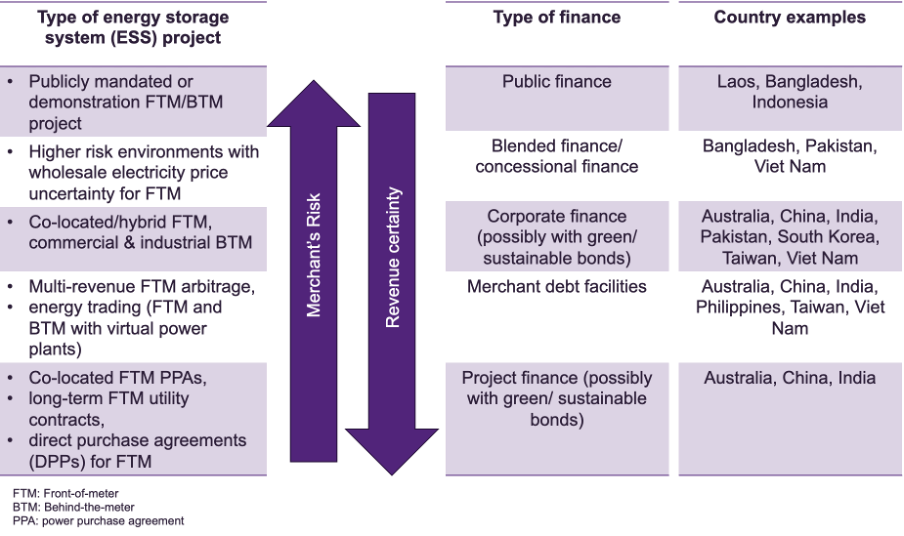
Investors should contract or hedge the risks that cannot be borne efficiently in the equity case: offtake and utility payment risk, delay of engineering/ procurement/ construction (EPC), battery performance and degradation, optimization performance, FX exposure, curtailment, network charges and regulatory change.
About the report
This guidance document was written for the Green Energy Network – Asia (GEN-A), an initiative by The University of Queensland in Australia, in collaboration with the Institute of Essential Services Reform (IESR) in Indonesia, Pakistan China Institute (PCI) in Pakistan, Renewables First (RF) in Pakistan, Climate Smart Ventures (CSV) and the Green Finance & Development Center (GFDC) in P.R. China.

Dr Christoph Nedopil is a UQ Business School Professor, a Visiting Professor at FISF Fudan University, Shanghai, and a Professorial Research Associate at SOAS University of London.
Christoph’s work focuses on green industry transitions in the Asia-Pacific region. He regularly provides advisory services and capacity building to governments, financial institutions, enterprises, and civil society on green finance, corporate governance and transition leadership.
He is the lead author of the UNDP SDG Finance Taxonomy, the Innovative Climate Finance Solutions report for the G20 in Indonesia, and the Green Development Guidance of the BRI Green Development Coalition under the Chinese Ministry of Ecology and Environment. He has further authored four books with translations in several languages and published articles in Science and other leading academic journals. Christoph is quoted regularly in Financial Times, The Economist, Reuters, Bloomberg, and other major outlets.
Before joining UQ, he served as Director of the Griffith Asia Institute at Griffith University, as the Founding Director of the Green Finance & Development Center and Associate Professor at the Fudan International School of Finance (FISF), Fudan University and previously as Founding Director for the Green BRI Center at the Central University of Economics in Beijing. He also worked for more than a decade with the World Bank in over 15 countries and served as a Director at the German development agency GIZ.
Christoph holds a Master of Engineering and a PhD in Economics from the Technical University Berlin, as well as a Master of Public Administration from Harvard Kennedy School.

Fabby Tumiwa
Fabby Tumiwa is Chief Executive Officer of the Institute for Essential Services Reform (IESR), an Indonesian think tank focused on energy transition and climate policy. A founding member of IESR, he has more than 20 years of experience in energy and climate policy, advising government agencies, businesses and development institutions on electricity regulation, renewable energy and energy efficiency. He served as an Indonesian delegate to international climate negotiations from 2006 to 2017 and chaired the Indonesia Solar Energy Association from 2021 to 2024.

Muhammad Mustafa Amjad
Muhammad Mustafa Amjad is Director Programs at Renewables First, a Pakistan-based energy transition think tank. His work focuses on renewable energy policy, power-system modelling and a just energy transition, including the development of provincial renewable energy policies and analysis of electricity-system costs. A Fulbright scholar, he holds a master’s degree in Mechanical Engineering from the University of Massachusetts Amherst, where he specialised in wind power systems.

Abdul Rehman
Abdul Rehman is Manager – Power Markets at Renewables First, where he works on power-sector planning, electricity markets and energy transition strategy, with a focus on distributed energy resources and grid flexibility. His previous work spans energy efficiency, public-sector solar deployment, rural microgrids and appliance standards. A Chevening scholar, he holds a master’s degree in Sustainable Energy Systems from the University of Edinburgh and a bachelor’s degree in Electrical Engineering from COMSATS University Islamabad.
Comments are closed.